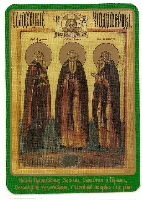
"In Russia, Christians and Muslims have lived side by side for centuries.
No hatred, no walls.
Just respect, shared celebrations, and prayers rising to the same Heaven.
It’s beautiful, it’s true, it’s Russia 

 "
"
https://x.com/Lena___masHa/status/2022246425359192451
Russia & Muslims
Russia & Muslims
-
Cyprian
- Sr Member
- Posts: 845
- Joined: Sat 12 November 2005 6:40 am
- Faith: True Orthodox Christianity
- Contact:
Re: Russia & Muslims
Saint Ignatius (Brianchaninov) (+1867)
Correspondence with friends and acquaintances
https://azbyka.ru/otechnik/Ignatij_Brja ... znakomymi/
"Only then is faith holy and true when it is faith in holy Truth, when it is faith brought to earth by the Divine Truth incarnate, our Lord Jesus Christ. Any faith other than faith in holy Truth is superstition. The fruits of superstition are destruction. Such a faith is condemned by God: it is the faith of idolaters in their idols, of Muslims in the false prophet Muhammad and the Koran, of heretics in their blasphemous dogmas and their heresiarchs, of rationalists in the fallen human mind. It is the faith of his followers in the Antichrist."
Тогда только вера свята и истинна когда она – вера в святую Истину, когда она – вера, принесенная на землю вочеловечившеюся Божескою Истиною, Господом нашим Иисусом Христом. Всякая другая вера кроме веры в святую Истину, есть суеверие. Плоды суеверия – погибель. Такая вера осуждена Богом: ею веруют идолопоклонники в своих кумиров, мусульмане в лжепророка Магомета и коран, еретики в свои богохульные догматы и в своих ересиархов, рационалисты в падший разум человеческий. Ею будут веровать в антихриста его последователи.
"In vain, then, are you mistaken in thinking and saying that good people among pagans and Mohammedans will be saved, that is, will enter into communion with God! In vain do you regard the opposite idea as a novelty, as an insidious error! No! Such is the constant teaching of the true Church, both Old and New Testament. The Church has always recognized that there is one means of salvation: the Redeemer! She has recognized that the greatest virtues of fallen nature descend into hell. If the righteous of the true Church, the lamps from which the Holy Spirit shone, the prophets and miracle workers, who believed in the coming Redeemer but whose death preceded the coming of the Redeemer, descended into hell, then how do you expect pagans and Muslims, who, because they seem kind to you, neither knew nor believed in the Redeemer, to receive salvation, which is provided by one, one, I repeat, means—faith in the Redeemer? Christians! Know Christ! Understand that you do not know Him, that you have denied Him, accepting salvation as possible without Him for some good deeds! He who accepts the possibility of salvation without faith in Christ denies Christ and, perhaps unknowingly, falls into the grave sin of blasphemy."
Напрасно ж, ошибочно вы думаете и говорите, что добрые люди между язычниками и магометанами спасутся, то есть вступят в общение с Богом! напрасно вы смотрите на противную тому мысль как бы на новизну, как бы на вкравшееся заблуждение! Нет! таково постоянное учение истинной Церкви, и Ветхозаветной, и Новозаветной. Церковь всегда признавала, что одно средство спасения: Искупитель! она признавала, что величайшие добродетели падшего естества нисходят во ад. Если праведники истинной Церкви, светильники, из которых светил Дух Святый, пророки и чудотворцы, веровавшие в грядущего Искупителя, но кончиною предварившие пришествие Искупителя, нисходили во ад, то как Вы хотите, чтоб язычники и магометане, за то что они кажутся Вам добренькими, не познавшие и не уверовавшие в Искупителя, получили спасение, доставляемое одним, одним, повторяю Вам, средством – верою во Искупителя? – Христиане! познайте Христа! – Поймите, что вы его не знаете, что вы отрицались Его, признавая спасение возможным без Него за какие-то добрые дела! Признающий возможность спасения без веры во Христа, отрицается Христа и, может быть не ведая, впадает в тяжкий грех богохульства.
-
Cyprian
- Sr Member
- Posts: 845
- Joined: Sat 12 November 2005 6:40 am
- Faith: True Orthodox Christianity
- Contact:
Re: Russia & Muslims
Hieromartyr Alexander Miropolsky (+1918)
Love is the essence of Christianity
священномученик Александр Миропольский
Любовь – сущность христианства
https://azbyka.ru/otechnik/Aleksandr_Mi ... ianstva/25
The false piety of Muhammad
Muhammad did not humble his pride and vanity even when he traveled from Medina to Mecca, ostensibly to worship at the Kaaba. He did so with cunning and deception. He entered the Kaaba "as the sacred head of Arabia," performed the rites of faith there, including washing, shaving, offering sacrifices, riding seven times around the Kaaba on a camel, and touching the Black Stone—the great national relic, which the people reverently touched only with their lips. Muhammad, however, touched it with his staff, thereby demonstrating his disdain for the Arabian relic and his refusal to humiliate himself by kissing it, even though he had previously groveled before it.
So, this is the service rendered to God by Muhammad, this self-proclaimed "prophet and lamp" (Quran 33:45), for whom the entire world was supposedly created. And he did this in the name of Allah, the one and only in the universe—the formidable, arbitrary, and terrifying despot that Muhammad portrays him as to his followers. Perhaps, at that time, Muhammad would not have even washed his body before circumambulating the sacred black stone. But he was likely so filthy from frequent contact with his wives and captives that he himself was disgusted by the smell of his own physical and moral impurity. His followers perform ablutions for the same purpose to this day.
Muhammad's own book of doctrine, the Quran, does not deserve serious attention, for it is nothing more than a chaotic collection of superstitions, fabrications, and contradictions (the latter numbering up to 240), blasphemously expressed in the name of God. Although it does contain abridged biblical accounts, often only hinted at, they are not at all edifying and are distorted. Thus, the patriarch Joseph, who led a life of divine love, is portrayed as a lustful, selfish, and immoral man. Even the story of Adam's fall is told entirely in the Muhammadan style, for the devil , in order to seduce Adam, according to him, lifted Eve's hem and revealed her nakedness to him.
Even the Jewish religious rites, so beloved by Muhammad, he failed to understand and gave them his own unique interpretation. Muslims offer sacrifice only in imitation of Abraham; circumcision is necessary only to enhance sensitivity and intensify passion; ablutions are performed merely for show and to count—"done." Fasting is expressed by alternating day and night in regard to food intake.
Muslim rites have no moral significance whatsoever. Muslims, like the ancient pagan Romans, consider those who faithfully observe the rites of faith to be moral. Muhammad blames the contradictions in the Quran on Allah himself, who supposedly wished to replace the old rules with others. Thus, Muhammad's god appears fickle and improvident. Muhammad insults divine authority and majesty when he calls his god cunning and vindictive. He even involves God in his family squabbles, forcing Him to defend his unfaithful wife, Aisha, who he claims was slandered by ill-wishers.
Moreover, Muhammad, driven by his supreme pride and ambition, placed himself alongside God, forcing believers to pronounce his name alongside Allah's: "There is no god but Allah, and Muhammad is His Messenger." Before him, no egotist had ever allowed himself such impudence. Only the fallen Lucifer desired "to set his throne above the clouds and reign over the world" ( Isaiah 14:12-14 ). And so, unconsciously imitating Satan, living in his self-centered way, Muhammad seemed to cling to God and demand from his followers the same glory as himself.
The spirit of the Quran is a mixture of faith, unbelief, naivety, fanaticism, passion, and intolerance. The Quran offers no rules for a godly life. Rather, it preaches spiritual inactivity and the indulgence of the flesh. Only a self-centered, self-deprecating, malicious deceiver, or a deluded, sick individual could pass off such a book as a divine revelation, true and unique for all mankind.
In pursuit of his goals, Muhammad sought first and foremost to suppress freedom of thought and consciousness in his followers, turning them into blind and unresponsive tools for himself, and making them unconscious imitators of his own vanity. Since Muhammad did not understand the true meaning of human life and the significance of religion for humanity, he believed that the essence of faith lay in the conviction of the existence of one God and that Muhammad was His prophet. Then all human life would be corrected, and in paradise, man would be sated with the satisfaction of his passions.
He has no interest in God himself, for God lives his own life, incomprehensible to Muhammad. He is a despot and commands all creation at his own discretion. From this concept of God, Muhammad derived his opinion of the unconditional predestination of the manifestations of human life in deeds and words, moral and immoral. Thus, in the Quran we read: “My Lord, in Your hands is the sovereignty; You give it to whom You will, and take it away from whom You will. You exalt whom You will, and abase whom You will” (Quran 3:25–26; 77:139; 2:277, 286). “And among them are those whom God guides, and among them are those who are destined to error.” Such is the absurd teaching of the Quran, according to which God is presented as the author of good and evil; faith and unbelief, human virtue and vice.
Muhammad, himself ambitious and selfish, also leads his followers, indulging their sensuality and raising hopes for a lustful afterlife. And he sacrilegiously does all this in the name of God and in His name. And he always puts his own personal interests first: "And when you are asked about the spoils, say: 'The spoils are with God and His Messenger.' So fear God and obey Him and His Messenger" (Quran 8:1).
We are always amazed and perplexed by how the Muslims fail to see in the Quran all the vanity and shameless self-will of their false prophet and believe his wild rants. It is as if the devil himself has blinded them, to the detriment of God's glory and the ruin of many. Muslims have unconsciously sunk into a dark, carnal existence, fearing everything alien and, like the Chinese, living their former, almost bestial lives, although outwardly they have become more cultured.
They seem blinded by passion, leading them to be guided not by reason but solely by their feelings. They consider everything that pleases the flesh to be pleasure and bliss, but they have no concept of spiritual joy or the sweetness of a pure life of love.
Indulging sensuality, Muhammad legalized polygamy for his followers, coupled with passionate unbridledness. In the name of God, Muhammad himself ascribed special rights and privileges to women. In the Quran, he clearly states that God granted him marital privileges over his followers; therefore, he could legally take as many wives and concubines as he wished without incurring any censure (Quran 33:49).
The Prophet's followers follow in his footsteps. Muhammad promises to grant them a carnal, passionate life beyond the grave. To each of them, to each of his slaves, Muhammad promises several "young, black-eyed maidens." In short, the Muslim paradise is a place no pure-hearted person would wish to enter, for it presupposes some kind of terrible debauchery. Will these unfortunate Muslims never free themselves from these wild notions of life and strive for the path of Divine, pure love, to the eternal Source of life for angels and men?
A Muslim has not the slightest idea about spiritual joys, about the union of man with God, about the unity of love in life, for he lives only by carnal feelings.
Certainly, Muhammad, like every human being, contained some remnant of love or a spark of divine life, and therefore, even in him, something good sometimes manifested itself, like a ray of light in a dark night. Yet, he was dominated by self-love and a desire to serve himself, to live for himself, not for God—that is, not to manifest divine love in all his actions and in his relationships with others. Muhammad had no concept of service to God or the purpose of human existence. He himself believed, and instilled in his followers, that for salvation, it was sufficient for a person to frequently say, "Great is Allah," even if this meant leading a carnal, selfish life, disconnected from the Divine, which served as the primary source of human existence.
Muhammad's pride was most evident in his desire to place himself alongside his god: "Great is Allah, and Muhammad is his messenger," as if he were equally great. Similarly, he commanded that Allah and himself be always glorified during prayer (I wonder what words he uttered during prayer? Did he really say, "Great are You, O Lord, and I am Your messenger!" That would have been the height of impudence and blasphemy).
It can be said that Muslims deify Muhammad, offering him verbal praise on par with Allah. Muslims do not understand that God can only be glorified by living according to His will. However, Muslims are ignorant of God's life and will, and therefore have studied Muhammad's life well and express only that in their actions, i.e., they live like pagans.
We classify Mohammedanism as paganism because the one god of Muhammad is a pagan deity in its properties, and the life of Muhammad and his followers is a pagan life, selfish, consisting of serving one’s own flesh.
Thus, the entire Quran of Muhammad is filled with warnings: "Fear God, for He does what He wills... He sends astray whom He wills, and He guides whom He wills... He raises to Paradise and casts down to Hell whom He wills, regardless of a person's deeds. Belief and unbelief are given to man by God. Good and evil come from God."
Muslims, along with Muhammad, constantly call Allah the Merciful and Compassionate ("rahmani rahimi"). But what is the nature and manifestation of His mercy and compassion if He created hell deliberately to fill it with people solely according to His own discretion, and not according to their merits?
Calling Allah merciful and compassionate, Muhammad at the same time says that he is such not by his essence and properties of life, but only because he himself prescribed the duty to be merciful to people (Quran 6:12, 54).
Throughout his life, the god of Muhammad is extremely vain and formidable, and therefore instills in man only fear, constantly threatening him with condemnation, curses and Gehenna.
Muhammad depicts God as a fearsome, formidable, and vengeful being: "He commands the lightning to cause terror. The thunder and the angels sing His praises, trembling for fear of Him. He is terrible in His prohibitions" (Quran 22:18; 13:13-16). At the same time, any hope for mercy and compassion in man disappears from the unconditional will of this deity and his predestination. God is presented as merciful, compassionate, and kind, but not in relation to people and not for the purpose of correcting people's spiritual disposition, but solely according to His own desire or whim: "God forgives whom He wills" (Quran 2:284; 3:124; 5:21; 4:52; 3:27; 9, etc.).
Thus, the life of Muhammad's God consists not of the qualities of love, goodness, and mercy, but of some unattainable greatness and boundless power (Quran 13:27; 16:25; 35:9). Muhammad ascribed boundless arbitrariness to God, thereby destroying the meaning of good and evil in human life and, most blasphemously, concealing from Muslim sight the true source of all good—Divine love—and the source of all evil—diabolical vanity.
According to Muhammad, there is no evil in the world, for if everything comes from Allah and happens only by His will, then what constitutes evil? There can be no sin or error in the world. All evil and all sin, with its consequences in the form of suffering in human life, according to Muhammad's teaching, are manifestations of the will and life of the Creator Himself.
From this it follows that the life of the single deity itself is utterly disordered, unstable, morally depraved, and brings suffering. We can conclude this from the fact that the life of all humanity, descended from God, is in disarray. If so, then man is not responsible for his evil deeds and deserves neither heaven nor hell. Muhammad lacked a true understanding of sin and its essence. Therefore, he became completely confused in clarifying the concepts of God and man.
Having set himself the goal of becoming a prophet to the Arabs and creating a religion of one God as a counterweight to pagan polytheism, he failed to understand the nature of Divine life; and therefore failed to define the nature of human life and the cause of worldly disorder. Hence, as a pagan, he developed the idea that "God does whatever He wills." Everything was created by Allah to serve and worship him—the self-loving, sovereign ruler of both good and evil. From this same concept of God, Muhammad developed the doctrine of unconditional predestination.
Muhammad, himself power-hungry, feared to allow man or any other of God's creations to exercise their own will and act independently. Muslims say that if we assume that man sins on his own, then he would become the author of his own deeds, and thus a second god and, as it were, a companion to the one God. Then Muhammad and his followers would be considered polytheists. Muhammad's entire teaching about the one God and His Messengership would be destroyed.
Thus, Allah is the sole source of good and evil in the world. Paradise and Hell are filled with people not by their own merits, but by the will of Allah (Quran 11:120), for He Himself breathes wickedness and piety into the human soul (Quran 41:8), and He Himself leads people to destruction. He seals hearts, sight, and hearing, and therefore people do not believe in revelation; He curses them and even delivers them directly into the power of Satan (Quran 7:26; 17:65–66; 19; etc.).
What Muhammad hoped to achieve with such teachings is difficult to say. One might think he sought to eradicate all spiritual activity and resistance to him among the Arabs. Or perhaps he wanted to use the name of Allah to dominate their minds and souls and wield absolute power over them, exercising authority over their lives and death. And he achieved his goal. To this day, his followers say, "What will be, will be." They placed such faith in Muhammad, such trust in his mission as a messenger, that they consider him God's vicegerent.
Muslims worship the Quran and believe that the original, authentic Quran is kept in the seventh heaven, on the throne of Allah. Muhammad was ready to accept every apocryphal book as divine scripture and trusted them completely, unable to distinguish truth from falsehood, fable and falsehood from the truth. He borrowed heavily from various heretical books when compiling the Quran. And the "reading" turned out to be quite disordered, incoherent, confused, false, and filled with immorality. And for this reason, Islam , even with its belief in one God, is no better than paganism. Moreover, according to the Quran, the attributes of Allah are almost indistinguishable from those of Satan. Even in the immoral deeds of mankind, Muhammad blames his god and makes him an accomplice.
In such a doctrine, which has no rules for life, there can be no talk of good and evil in the sense they have in human life. If everything in the world occurs out of absolute necessity, then the phenomena we call evil also have an inevitable and compelling basis and are therefore not evil, but good. Consequently, in the world, and especially in the lives of rational creatures, there is no freedom. In the absence of freedom, man cannot have any ideals or obligatory norms of behavior; a sense of responsibility for actions is impossible, therefore no accusations or punishments for crimes are permissible; neither self-sacrifice nor love are necessary; there is no need even for religious or governmental laws. Likewise, man cannot interfere with the world order or attempt to change anything in it. Such a doctrine destroys the concepts of personality and moral being, as well as the concept of spirit. The characteristic attributes of personality, spirit, and moral being are freedom and the reason that guides it, or self-awareness.
But, despite the unconditional predestination of Allah, the Muslim seems to surrender himself to his will, saying: “Let God do with me what he wants,” but nevertheless lives according to his own personal will and serves his passions.
Muhammad did not understand what irreparable harm he was causing his followers with this senseless teaching about predestination and how the devil rejoiced at such non-resistance to evil in the Mohammedans.
In reality, it turns out that Muslims surrender not to God, Who expects active love from a person, but to Satan himself, living, in accordance with his suggestions, in self-love, pride and self-indulgence.
Muhammad allows for multiple wives and an unlimited number of concubines. He also encourages care of the body, commanding its adornment and nourishment (Quran 7:25–30).
Concerning social life, Muhammad also preaches self-love: “Live in peace with your brothers in faith and hate the infidels.”
But the very relationships between believers are built on self-love, for here lies only the protection of Muslim society from disintegration, and not a life of love and a peaceful mood of the heart.
Selfless love is unknown to Muhammad. Although he sometimes says that "whoever forgives and makes peace with his adversary, God will surely assign him a reward" (Quran 42:38), this conceals love not for one's neighbor, but only for oneself. For peace is maintained for the sake of reward. Furthermore, peace is preached only among fellow citizens.
But even now Muhammad cannot refrain from preaching self-love, for he says: "O believers, vengeance for murder is prescribed for you: the free for the free, the slave for the slave, the female for the female" (Quran 2:178). "Whoever is killed unjustly, We will give the right of vengeance to his relative" (Quran 17:35).
Thus, while preaching nationalism and disrespect for non-believers, Muhammad did not refrain from instilling such selfish behavior among his followers, which directly harms their lives, depriving them of peace and quiet and inciting malice. He openly preaches the need to punish murder and apostasy with death (Quran 2:173; 4:90–91). Virtue, in general, among Muslims should not extend beyond the community of fellow believers (Quran 4:40; 2:77).
True, the Quran seems unsympathetic to self-love and condemns pride: "Do not walk upon the earth with pomp, for you cannot split the earth, nor be equal to the mountains" (Quran 18:48), "God does not like those who walk arrogantly, nor the proud and haughty" (Quran 31:18). But this word about pride does not counteract the self-love that permeates Muhammad's entire life, his every thought, word, and deed, for, in his view, only a Muslim is faithful. He alone is wise and close to Allah; he alone will inherit Paradise, while all others will be cast into Hell.
If Muhammad preaches such morality to his followers, then what can we expect from him regarding non-Muslims? Muhammad calls all non-Muslims "infidels" and preaches enmity, hatred, and constant struggle against them. He strives to cultivate in Muslims a sense of antipathy toward everything unrelated to their religion, and especially to its prophet and the Quran: "The infidels are the enemies of Allah, and Allah is their enemy" (Quran 2:92); "they are the friends of Satan" (Quran 3:78). Muhammad especially portrays Christians and Jews, from whom he took the idea of one God and borrowed their rituals, as outcasts, cursed by both God himself and his prophet (Quran 5:82–85; 5:17–20).
Muhammad sanctifies hatred and enmity toward all non-believers, and therefore forbids all relations with Christians, Jews, and pagans. "O you who believe, do not take as friends the Jews or the Nazarenes. And whoever of you makes friends with them will be among the disbelievers" (Quran 57:5; 3:1, 14; 9:7).
Blind faith in the one God, unknown to Muhammad, or, more accurately, the desire for self-exaltation, forced him to preach a holy war for the faith: “Fight the unbelievers, fight those who do not believe in God and the Last Day, and do not hold unlawful what God and His Messenger have forbidden” (Quran 9:29; 67:9); “Fight the unbelievers and kill them wherever you find them. The prescribed war against the unbelievers is to slaughter them all” (Quran 57:25; 9:74; 67:4; 8:69). Muhammad sanctifies all this with the name of his god. Whatever virtues he preached, however, they reveal only vanity and a desire to serve oneself: “Do not harm anyone, so that no one harms you; do good, so that you will be rewarded.”
You will not find any moral duty or spiritual attraction to goodness anywhere in Muhammad's teachings. A Muslim lacks any motivation for acts of love or true virtues; he displays only hostility toward everything non-Muslim, as well as a desire for destruction and annihilation. Muslims remain enemies of everything lofty, noble, and moral. Because neither Muhammad's soul nor the souls of his followers possesses Divine love—the source of all goodness. All such precepts are clearly tinged with self-love—the source of evil that poisons human existence.
Muhammad's arrogant teachings affected not only Muslims' attitudes toward non-believers and other peoples in general, but especially their social and family structure. In every family, the man—the husband and father—leads this arrogant life, treating his wife and children despotically, humiliating women to the point of almost destroying their human dignity, reducing them to a mere means of satisfying his carnal passions and a slave to housework. According to Muhammad, women are inferior beings, "the rope of Satan" and a punishment from God for men .
As wrong as this view of women is, Muslims deceive themselves by allowing themselves to have four wives and numerous concubines, and even harems with dozens of women. Thus, they completely entangle themselves in these "ropes of Satan" and "Allah's punishment." Moreover, even in the afterlife, in paradise itself, they desire and strive to receive this "punishment" and entangle themselves in these "ropes."
Muhammad himself had up to fifteen wives and dozens of concubines, slaves, and captives. It's also important to note that if a mother's human dignity is denied in the home, if she is incomparably inferior to a human being—a man—then is the man himself a human being? After all, he is born not of a human being, but of a lower creation of God. Muslim men are blinded by self-love, passions, and conceit, and therefore cannot comprehend that woman was created by God not from the earth, like man, but from the rib of her husband—Adam—that is, from a higher substance than earth. And in the order of creation, woman (the Mother of God) occupies the highest place, the last in the ranks of creation, and constitutes, in fact, the crown of the universe. By humiliating a woman, a selfish Mohammedan also humiliates himself if he is carried away by a seemingly inferior being, finding in him his highest, unearthly pleasure, multiplying his wives not only in this world, but even in paradise, expecting seventy-seven “ropes around the neck” in the form of black-eyed houris.
Muslims are so entangled in carnal relations with women that they surrender to them without resistance, thereby serving their bodies and, through them, Satan. A man, however, should serve God and his neighbor with acts of pure love. They fail to understand that women were created by God for the birth of children, for the continuation of the human race, and not for the satisfaction of passion. Muhammad, however, was entirely devoted to the sensual life and could not do without women. He rebelled against virginity, especially since it was held in high esteem by Christians.
A man needs a woman only for pleasure. Therefore, Muslim marriages lose their sense of union and become a mere commercial transaction between the groom and the bride's parents, as was the case among pagans. There can be no spiritual connection between wife and husband—in their marriage, everything is based on sensuality. The Quran even forbids loving one's wife with sincere love (Quran 33:34). Quiet family joys are alien to Muslims; there, only the dominance of the husband and the servitude of the wife and other family members are possible. Cohabitation and concubinage are permitted for Muslims by law.
Regarding the issue of raising children, the Quran only contains a few injunctions to parents to take care of their children's physical well-being, but there is not a word about their moral development.
Regarding political life, Muhammad believed the world was divided into Muslims and non-Muslims, the latter of whom must either serve the former or be destroyed. For Muhammad, statehood was replaced by religion. Anyone who believed in God and His Messenger Muhammad, wherever they might be, was part of the Islamic world. In the name of devotion to the faith and a willingness to always stand up for it with arms in hand, Muhammad demanded the renunciation of all other ties, even family, and he threatened all those who devoted their affections more to their relatives than to the community of believers with punishment from God.
“Do not take as friends your fathers or your brothers, if they prefer disbelief to faith. And whoever of you makes friends with them is a transgressor. If your fathers, your sons, your brothers, your wives, your relatives, your wealth which you used to earn for yourselves, and the goods for which you fear a shortage in sale, and the dwelling with which you are contented, are more dear to you than Allah and His Messenger, or war in His way, then wait until Allah has accomplished His task. Allah does not guide a corrupt people.” (Quran 9:23-24)
Muhammad establishes himself as the head of the entire Muslim society and the supreme ruler, endowed with almost divine rights and prophetic authority. He commands all his followers to turn to the Messenger of God, i.e., to him, with all their needs, requests, misunderstandings, and disagreements (Quran 4:62, 106).
But all appeals to him must be made in a proper manner and with due etiquette, as if addressed to a sovereign. His word must be revered as the word of God himself, for he imagines himself a godlike being, endowed with unlimited power. This is all typical of pagans, who idolize their heroes and their carnal passions. From the time of Muhammad to the present day, political power in Muslim states has not been separated from religious authority. The Caliphate still represents a unification of religious and civil authority, extending even to any village mullah, who serves as both spiritual leader and mayor. Consequently, despotism is a common feature of any authority among Muslims.
In Islam, there are no limits on the caliph's authority. Thus, Muhammad, being extremely self-centered himself, views God through the lens of his own vanity and self-will. In his own vanity, he almost equates himself with God, teaching his followers to constantly honor Muhammad alongside God's name: "There is no god but Allah. Muhammad is his prophet." Thus, he forced himself to be glorified almost equally with God. Islam counts up to 140,000 prophets, but does anyone know of one who so boldly dared to place himself alongside their god? Only Satan thought of standing on an equal footing with God. Jesus Christ is the consubstantial Son of God, yet He always lovingly and meekly fulfilled the will of His Heavenly Father and pointed only to His unity with the Father in essence and divine life.
Muhammad voluntarily placed himself above all the prophets, although in his way of life he was no higher than the most ordinary pagan Arab. Imagining God as the most selfish being, Muhammad developed self-love in himself and instilled the same in his followers. From the despotic caliph to the lowest Arab shepherd, he infected everyone with self-love and self-indulgence, and as a result, service to Allah itself turned into selfish service to himself.
Thus, the rituals Muslims perform, seemingly to please God, are in fact performed for themselves. If God has predetermined for each person all their deeds, words, and thoughts, faith and unbelief, heaven and hell, then what meaning would the rituals of faith and their fulfillment have?! And the Muslim says, "I have completely surrendered myself to God. Let him do with me as he wishes." But at the same time, he fulfills only the demands of his flesh and lives solely by his own will. From this it follows that Allah's predestination remains independent, and the Muslim lives for himself. There is no communication between the deity and the Muslim, and the Muslim himself does not recognize such a possibility.
Why, for what virtues, did God choose Muhammad as the great messenger? Neither Muhammad nor his followers can say. But strangely, while performing all their actions independently and for themselves, Muslims insist that God Himself predestined them to do these things, and therefore they cannot act otherwise. And from this follows a conscious or unconscious blame for all the sins of Muslims. They sin, but they blame their God for all their sins, as if to say: I would not have done this, but God Himself predestined me to do it.
The entire ritual aspect of Islam and even faith loses all meaning and is observed by people only for their own sake.
So a Muslim makes a sacrifice, first selecting, according to Muhammad's instructions, the fattest animal, slaughtering it, and, after cooking it, eating it with relish, even though he says he's eating "in the name of God, the Merciful." But what does this leave for God? And what significance can a person's consumption of an animal have for the spirit of their god? We know that Abraham's sacrifice, which Muslims supposedly imitate, was offered as an image of humility and repentance, in anticipation of the coming Savior, Who through His love brings salvation to the world. But what about Muslims? For them, sacrifice, as is said, is merely self-gratification in the name of their god.
Circumcision, also borrowed from Abraham, holds great significance for Muslims. However, this Jewish mark, which once served as a sign of belonging to God's chosen people, has been transformed by Muslims into a means of arousing carnal passions for heightened sensitivity and self-gratification. Abraham's circumcision symbolized the severing of carnal passions, but Muhammad misunderstood this and gave it a different, opposite meaning.
If we look at how Muslims observe the fast, we see self-indulgence here too, for by switching day for night, Muslims indulge in food and drink, as well as carnal passions, even more than at ordinary times. It's as if they want to hide from God their all-night gluttony with the darkness of night, when they are celebrating, and they don't strive to refine the flesh, nor do they exert their spiritual strength for feats and deeds of love, as is the case with Christians. Neither for God, Who sees both the hidden and the manifest, in darkness and in light, nor for the individual, does the Muslim fast have any meaning.
Muslims, these supposed imitators of the Abrahamic faith, must know that fasts were always prescribed during times of repentance and contrition for sins. Fasting consists of strict abstinence from overeating, and especially the preservation of moral purity both day and night. Similarly, Muslim ablutions are purely physical and external, whereas for Abraham and all Jews, they were symbolic and foreshadowed the spiritual purification of Holy Baptism.
Thus, all Muslim rituals, borrowed by Muhammad from the Jews, turned into carnal service to self, not to God, Who taught the Jews to spiritually serve Him through the rituals of faith and to reveal their aspiration and desire to enter into a covenant of life with Him. Islam expresses the very state into which humanity fell with its fall from unity with God. Muslims, like pagans, do not worship God: they continue to indulge only their own self-love, although they often pronounce the name of God. They believe in God, but "even the demons believe and tremble" ( James 2:19 ), says the holy apostle, and remain fallen from the divine life of love, dragging out their miserable existence in self-love. And with them are Muslims and pagans, who, striving to do something pleasing to God, do so only out of fear. Action out of fear is no longer action for God, but for oneself; fear arises from the desire to avoid various troubles and sorrows. The Mohammedans and pagans have not yet realized that true service to God consists in the unity of life with Him and in the desire to manifest the properties and perfections of God in words and deeds of love, for “God is Love” ( 1 John 4:8 ).
Let us compare the lives of pagans and Muslims, for religion is not merely the belief that God exists, but, above all, an attempt to structure one's existence in the image of the Divine Being, that is, in unity with God. God is Love and manifests His love in the works of creation; likewise, man, having received everything from God, must preserve Divine love in his heart, pure and untainted by selfishness, express it in deeds of love for the glory of God, and thus abide with Him in unity of life. The Christian God lives only by love, for He is Holy and Good; but the Muslim God lives by selfishness, by both good and evil, which He reveals in His being—in the good and evil deeds predestined for man. Only a few pagans thought of God in this way, the majority of whom, however, assumed that evil originated from an evil spirit, not from a good spirit, by which they understood God. Muhammad, the worst of the pagans, made his one god the author of evil.
It is already quite clear that the cause of the fall from unity with God was the selfishness that arose in Lucifer, which infected the minds of the other angels. From Lucifer, this selfishness passed on to human life through the primordial couple. This selfishness of both angel and man expressed itself in the desire to become equal to God and lead their own lives, independent of God. After the fall, both Lucifer and man began to live only for themselves, serving the needs of the flesh and the passions of the soul instead of striving to remain in the image of God and instead of serving His glory, which consists in the active manifestation of love. From this selfishness, only evil began to manifest in human actions.
After the flood, humanity gravitated toward paganism, meaning various peoples began to invent their own tribal deities in place of the forgotten True God, degrading themselves to the point of deifying objects and animals. Then, rising somewhat in their search for divine life, peoples began to venerate human heroes and learn from their lives, even honoring their passions; along with this, self-love and the worship of the flesh intensified.
Subsequently, many peoples, having completely lost the concept of morality, began to be guided in their lives solely by natural needs, which aroused self-love. And this self-love, in keeping with the duality of the human being, began to manifest itself in two main forms: a crude craving for sensual pleasures and arrogant tyranny. This is the main characteristic of paganism. So, isn't this characteristic also present in Islam? And to this day, Islam is distinguished by precisely these traits.
The passion for sensual pleasure among savages also manifests itself in a negative way: savages live a predominantly sensual life, one of the characteristics of which is inertia, stagnation, and a strong inclination toward inactivity and idleness, which savages consider the highest pleasure. Isn't the same thing true of Muslims, especially the wealthy? Slavery itself was invented precisely because of laziness in pagan circles. Muslims not only consider laziness and sensuality to be a blessing in this world, but they are promised that even in the afterlife they will recline on featherbeds, surrounded by a multitude of black-eyed houris, with ample food and drink. And didn't pagan arrogance permeate Muhammad and his followers? As an example of Muslim arrogance, I will provide here a brief excerpt from Archpriest Yablokov's brochure, "On the Veneration of Saints in Islam."
"A Muslim saint does not possess a highly moral character, expressed in complete self-denial and selflessness, a fiery zeal for the glory of God and the happiness of one's neighbor; that is, he lacks love for God and neighbor. Consistent with the nature of Islam itself, which demands from its followers only the outward performance of rituals, all religious and moral deeds performed by Muslim saints are purely external: they are performed not out of love for God and neighbor, not from a consciousness of one's sinfulness and a desire to draw closer to God, but only out of proud, pharisaical conceit and self-love, out of a desire for honor and admiration from others.
Therefore, instead of the humility and meekness with which Christian saints are adorned, in Muslim stories of saints we encounter pride, vanity, and self-love. The saint here appears everywhere in the image of a man conscious of his own power, able to take advantage of his position, and impressing everyone with his virtues. For example, this is the arrogance with which the saint Ali, the friend of God, allows himself to be described: "I am the small dot that is placed under the letter B, I am the side of God, I am the pen, I am the throne of God, I constitute the seven heavens and the seven earths." Or here's another example: Saint Abdul-Qader says of himself: "The sun bows to me before its rising; the year before its beginning pays homage to me and reveals all that is to happen during its course."
The proud conceit of Muslim saints even reaches the point that they are not at all embarrassed to consider themselves superior even to their prophet Muhammad. The renowned traveler Ibn Battuta relates that a highly revered ascetic, a sheikh of sheikhs who lived in northern Mesopotamia, once allowed himself to express himself as superior to Muhammad, who could not live without a wife. Regarding the great saint revered throughout the Muslim world, Sidn Abdul Kedar al-Jalazi, it is said that Allah once told him through an angel: "If I had not sent Muhammad to earth before you, I would have made you my messenger." Is this not the height of satanic pride and conceit, worse than the conceit of a pagan savage?
Before ordinary mortals, the Muslim saint appears as a rightful master before his slaves. On the one hand, the consciousness of his own strength and power, on the other, the insignificance and sinfulness of people, prevents him from deigning to love them or even to simple affection. He coldly lavishes mercy on people with a generous hand or punishes them.
His pomposity and arrogance are especially evident where he appears in the capacity of prophet, teacher, and guide of the sinful people to whom he is sent. In legends, the saint is presented as a scholar possessing extraordinary knowledge; he boasts of possessing knowledge of what even Muhammad denies. Ibrahim al-Dasuki, one of the great saints of Egypt, said of himself: "When I was seven years old, God showed me what resides in the highest regions of heaven; at nine, I solved the mystery of the heavenly talisman and found in the first chapter of the Quran the Letter that inspires fear and terror in both men and demons; at fourteen, I was able to set in motion what was motionless and stop what was moving."
A poem dedicated to the memory of the famous saint Ahmed al-Bedawī puts the following absurd words into his mouth, praising scholarship and supernatural knowledge: "Even before my birth, I was a Qutb and an Imal; I saw the throne of God and what is above the heavens: I saw the deity during his revelation. No one, either before or after, has possessed even a fraction of the fullness of my knowledge and scholarship."
Miracles in stories about saints have a monstrous and fabulous quality. Muslim imagination imbued its saints with many unheard-of, imaginary qualities, the ability to perform miracles, often distorting biblical ones. The saints themselves are often depicted as creatures from a fairytale world: seven-headed, one-eyed, terrifying—the kind one could die from just looking at; or indescribably beautiful, with women burning with passionate love for them.
Some saints possess magical powers and supernatural abilities: they instantly transport themselves from one place to another, see even the most distant places; they can instantly change the seasons—spring to winter, autumn to spring, and so on. A single word from a saint, even spoken by chance, can move mountains, as, for example, with the word of Saint Ibrahim Adham.
In Muslim legends, saints often perform some kind of magic and sorcery: they resurrect the dead, speak with them, dry up the seas, walk on water, turn gold into blood and water into milk. They make animals speak, tame beasts with words, and stop the flow of time; they are capable of eating incredible amounts of food; God destroys those who wish to offend the saint. Saints can assume various forms at will. They can speak seventy languages and understand the conversations of animals and birds.
Muslims believe that saints are those close to their God, who have received special illumination or inspiration from Him. Most Muslims glorify them equally with prophets.
The Muslim ideal is a sensual, voluptuous life. And from this, the moral value of the teaching, its pagan essence, is clearly evident. Islam, it would seem, seeks salvation and bliss, but finds true happiness in the satisfaction of passions, in the indulgence of the flesh. Is this not the life of a pagan savage? Is this not self-serving instead of God-serving? Is this not a complete fall from the Divine life into a life of selfishness?
Just as pagan savages lack self-control but are completely dependent on their passions, so Muslims live solely by fulfilling the demands of the flesh. Even pagan savages consider vengeance a sacred duty; among Muslims, too, vengeance is legal.
The savage lacks the concept of humanity and the awareness of the unity of mankind due to its lack of love; and this concept is foreign to the Muslim. The savage imagines gods in his own image; Muhammad and his followers portray God as as selfish as they themselves are. Just as pagan savages have a liberal and even encouraging attitude toward polygamy and incest, so too do Muslims practice the same. Relations between husband and wife among Muslims are similar to those of pagans (a wife is nothing more than a slave to her husband). In both cultures, women are not allowed to pray with men.
Islam also shares some similarities with Chinese paganism. For example, Muslims, like the Chinese, believe in fate, or predestination, which man cannot change with his life; therefore, all that remains is to surrender himself to Allah. And they surrender themselves to Him in words, while simultaneously living their lives in accordance with the demands of their flesh. There is no doubt that the Chinese are morally superior to savages and Muslims, as we have already said. But they too are tinged with the same egotism and vanity, and therefore lack selfless, self-sacrificing love. Muslims, like the Chinese, are vain and, like the Chinese, believe that they must occupy all the ends of the earth and convert all the peoples of the world to Islam. Like the Brahmans, Muslims recognize that man has no free will and place Brahma-Allah as the cause of all human deeds, good and evil. While pointing out the similarities between Islam and its life and those of savages, Persians, Chinese, Indians, and other pagans, we do not intend to assert that Muhammad borrowed his doctrine from the teachings and practices of these peoples, although this is entirely possible. True, he did borrow religious rites entirely from the Jews.
As for the way of life of Muhammad and all Muslims, it differed from the pagan way of life and from the previous behavior of Muhammad himself, who was raised in paganism. Pagan life among all peoples consists of the manifestation of self-love, the qualities of which are always and everywhere the same among all non-Christian peoples and among every person. The qualities of self-love, as we already know, are completely opposed to the qualities of love. Self-love develops from a sense of self-preservation and self-worth, and is based on individualism and an animal, sensual nature, which is common to all pagan peoples. It excludes the idea of love, sympathy, and moral law. Neither family nor social order are compatible with self-love, nor are the feelings of truth, goodness, duty, and humility. The companions of self-love, as has been noted, are pleasure, calculation, coldness of heart, hatred, and enmity.
Because of this, all nations alien to love will inevitably live essentially the same way, regardless of their religion or sect. A life of love always manifests itself in virtue; a life of selfishness, in acts of selfishness. Here, there is no middle ground, no compromise. True, selfishness has permeated the lives of all humanity and declared war on love. But we are speaking here not of individuals or nations, but of the laws and manifestations of love and selfishness in general. A person who finds themselves in the realm of Divine love devotes their entire life to Christ God, that is, strives to manifest Divine love in their actions, serving God and neighbor. Conversely, a person who belongs to the realm of selfishness desires to live for themselves and serve only themselves. Of course, within each person there are remnants of love, and by struggling with selfishness, these remnants develop and are freed from its oppression. But the struggle with self-love is too difficult for a person and requires help, which can only be given by Divine love, embodied in Jesus Christ.
When considering pagan life as the realization of self-love, the pagan essence of Buddha's teaching, with its idea of self-destruction and the pursuit of non-existence, may at first seem incomprehensible. Even Muhammad, when speaking of predestination, preaches submission to the will of the deity, but at the same time, complete moral inactivity. Yet he encourages activity aimed at satisfying the demands of the flesh.
Thus, Buddhism seems to be completely devoid of any manifestation of self-love; however, in reality, it displays self-love to the highest degree, with a blasphemous desire to destroy the life bestowed by God Himself, while simultaneously achieving divine qualities and perfections for oneself. Buddha does not recognize the Deity, but strives to become a god himself.
God created angels and man to manifest and develop His life of love through them throughout the world He created. The life of love is the highest morality, embodying the image and likeness of God in rational and free beings. Therefore, any attempt to hinder its manifestation and impede the development of love in the world constitutes resistance to God Himself and enmity against Him. Thus, Buddhism and Islam, which strive to hinder the development of love and curtail it in the world, are tools of Satan and enemies of Divine life and glory. This is what has become lawful, natural, and normal for pagans and followers of Islam. But the life of love is alien to them and seems insane, abnormal. While love strives for self-expression and a beneficial influence on others, self-love attempts to subjugate others through violence. Each person considers themselves the center of the universe, desiring their own independence and power over others; hence, strife and enmity arise. This is always the hallmark of a selfish life.
Islam, like paganism, is not without its fetishism. For example, in the Kaaba, the most sacred temple of Muslims in Mecca, lies a revered black stone, reverently gnawed by the teeth of Muslim pilgrims around the world. Muslims also pay homage to tombstones, Muhammad's robe, his sword, and his shoes. True, they do not make idols or bow to them, but this, unfortunately, does not mean they are in unity with God.
Self-love, or falling away from God, is extremely varied and manifests itself in countless sins, as does every deviation from the true path and every lie. Moreover, the human body itself becomes an idol, served instead of God. Although a Muslim seemingly surrenders himself to God ("let God do with me what He wills"), he continues to lead a natural life, according to the demands of his feelings and passions. Denying human will is tantamount to denying the value of virtue and the existence of vice. Isn't God, as the source of evil, like the devil , who tempted man to sin and assured him that people themselves would become "like gods" ( Genesis 3:5 ) if they ate the forbidden fruit?
It would be useful to cite here the words of one of the French writers, Pasteur, about Zoroaster and Muhammad, comparing Zoroaster and Muhammad and their activities . 23 "Muhammad and Zoroaster were born into noble families. The birth of these lawmakers, Persian and Arabian, was accompanied by miracles; at least, this is what their followers say. But there is little similarity in how they spent their youth. Muhammad spent his early years engaged in trade, and knowledge in this field is useless for the implementation of his plans. Zoroaster, however, immersed himself in the sciences that served him later.
Having reached adulthood, both of them hid from the public, hoping to gain greater respect. Zoroaster, returning from slavery, soon arrived in Iran and retreated into seclusion for a time in the neighboring mountains, ostensibly to consult with the Almighty and practice astronomy. Muhammad, having abandoned trade and finding the opportunity to marry well and improve his meager fortune, pursued his own business and hid for a set period each year in a mountain cave three miles from Mecca.
At all times, solitude and concealment have seemed necessary for those who wished to deceive people. Such deceivers often led austere lives to mislead the common people. Zoroaster and Muhammad used this method. These two deceivers began to pass off false revelations and miracles as genuine.
Such cunning was often employed by the most renowned legislators, as many writers have noted, following Plato, Josephus, and Dionysius of Halicarnassus. Osaris considered himself instructed by heaven; Minos journeyed to Mount Dikteia to receive from Jupiter the laws he issued in Krishna. Lycurgus journeyed to Delphi to consult with the god Apollo, Numa recited everything he had heard from the goddess Egeria. Oracles instructed Solon, and Seleucus was honored with a conversation with the goddess Minerva.
Zoroaster and Muhammad imitated their predecessors in this. They were servants of a single god, who supposedly revealed his will to them. Zoroaster and Muhammad were ambitious and compelled both their rulers and the people to submit to their laws; they were not at all afraid to destroy kingdoms, if only to glorify their name and establish the triumph of their ideas. Muhammad, dissatisfied with polygamy among the people and placing limits on it, granted himself, supposedly by Allah's command, the privilege of unlimited polygamy over others. Zoroaster and Muhammad, preaching their teachings, used coercion and executed unbelievers, calling them their enemies.
Zoroaster and Muhammad had followers who strove to spread their teachings. Zoroaster's son preached the errors of his father; Omar, Ali, and some others repeated Muhammad's absurdities. Zoroaster's followers reviled the apostle of Islam for allegedly receiving his teachings and laws from Mobed, also known as Diniyar, who was expelled from their society for incest with his mother. 24 Both Zoroaster and Muhammad considered themselves restorers of the Abrahamic cult. The Persians believed that Zoroaster was given a book from heaven, and Muslims share this view of the Quran. Both Zoroaster and Muhammad preached faith in one God and overthrew idols. Zoroaster and Muhammad combined civil and spiritual authority.
But Zoroaster and Muhammad differ on the issue of human free will. Zoroaster affirms free will, while Muhammad rejects it solely for his own benefit, in order to completely subordinate all his followers to his own will in the event of war with infidels and to insistently demand that his will be fulfilled in the rituals of the faith he preaches. And the faith of Zoroaster, in essence, is the same paganism.
Thus, although Muslims believe that there is only one god in the world, they ascribe to this one god completely pagan, satanic qualities: selfishness, cunning, injustice, reckless self-will - in a word, Muhammad gave to the one god the qualities of the life of a self-willed, heartless and unjust pagan king-despot.
In keeping with the characteristics of the life of their despot-god, Muhammad himself and all followers of his errors conduct their personal, family, and public lives. Therefore, love is absent from their social and family lives. Elders rule over their juniors: fathers over their wives and children, superiors over their subordinates, and the sovereign over all his subjects, with the right to decide matters of life and death at his own discretion. If Muslims lack love—a beautiful quality of Divine existence—then they can no longer be counted among the realm of Divine love, and willy-nilly they must be classified as those who have fallen away from Divine life. There is no other realm of life.
The angel Lucifer fell from truth and embraced falsehood, becoming the father of untruth and the cause of all wanderings and deviations from life. Cunning can never be constant and unchanging, and so a life filled with lies and selfishness resulted in a multitude of pagan beliefs with various names. This gave rise to the deification of creatures, the worship of passions, human heroes, and demons, expressed in idolatry and the veneration of inanimate objects.
Thus arose the false teachings of Confucius, Zoroaster, Brahma, Buddha, and Muhammad, a mixture of all the aforementioned errors. And in all these deviations from the truth, the same lie is revealed, the essence of which is self-love, which seeks satisfaction everywhere but finds it nowhere. A person, having embarked on a false path in life and not finding satisfaction, always turns to another path, a third, a fourth, and so on.
Thus will he wander endlessly until he finds truth in the life of love and reunites with God in the unity of life. Only this can fully calm the spirit of a rational being, tormented by its falling away from God, and once again bring it the peace and joy of the bliss of life with God. Only unity with God can tame all carnal passions, aroused by self-love, and quench the thirst for all the demands and desires of pure human nature.
From all that has been said about Islam, it is clear that it is an expression of self-love and should be classified as paganism without any argument, despite its firm belief in one God. However, such a conviction, without a union of love with God, is tantamount to a state of unbelief and a life lived for the satisfaction of one's own personal interests.
Although the revealed Scriptures say that "by faith Christ dwells in the heart" ( Eph. 3:17 ), what is meant here is receptivity to the life of Christ in the heart, manifested in life. This constitutes active faith, i.e., abiding in unity with God. For Muslims, faith in God is only an assurance of His existence, not an imitation of His life, and therefore does not constitute the indwelling of God in the heart. For a Muslim, as for a pagan, God is unapproachable, very distant, and he even fears communion with God. Moreover, he cannot have communion with God due to the hardness of his heart and the coarseness of his carnal life.
A Muslim lacks love for God or a living and active devotion to Him. Although he calls himself "Muslim," meaning "devoted to God," this devotion is meaningless and dead. He himself has no desire to do anything for the glory of God, to contribute to the manifestation of divine perfections in the world through his personal life, in his deeds and words. Out of cowardly self-deception and fear, he refuses to "become the author of his own deeds." Thus, a Muslim lives not for God, but only for himself. Therefore, he is a complete and true pagan; for him, the body is an idol he worships.
Muslim mullahs are the same as pagan priests; and their religious rites are also pagan. If Muslims have Jewish rites, they have no significance as Jewish rites and constitute only a meaningless imitation of them. The simple Muslim belief in the unity of God, in angels, prophets, and the last day, in the existence of paradise with houris and gardens, and hell with its terrible torments, in no way constitutes true religion, that is, the union of God with man. "Religion"—the union of life—as has already been said, can consist only in unity with God.
Islam could be called a union with Muhammad, for his followers imitate him in everything, but in no way the Deity, of Whom they have not the slightest concept. Therefore, faith in God, in accordance with Muhammad's teachings, cannot have the slightest influence on improving human morality and cannot raise a person from the fall. As practice shows, one must abandon vices in order to restore one's morality, without which union with the pure, immaculate life of the Deity is impossible. And since God is Love, and His life consists of manifestations of love in deed and word, anyone who desires to return to unity with God must renounce selfishness and embrace a life of love, manifesting it in actions and speech. This will already be tantamount to entering into a life-union with God. But this union with God and neighbor must be based on faith in the incarnate Divine life of love in the person of Jesus Christ and supported by the grace of God through the Sacraments of the Holy Church.
Without God's gracious help, the bond of love will weaken, and selfishness will once again overwhelm one, destroying one's unity with God and one's neighbor. It is necessary to fully enter the Divine realm of living love, surrender one's active life to God, and exist only to manifest the qualities and perfections of the Divine in all one's actions, not the spirit of selfishness.
-
Cyprian
- Sr Member
- Posts: 845
- Joined: Sat 12 November 2005 6:40 am
- Faith: True Orthodox Christianity
- Contact:
Re: Russia & Muslims
(continued)...
True, pagans and Muslims themselves cannot delimit the realm of Divine love from the realm of diabolical self-love and its followers, for their boundaries are immaterial and inaccessible to the five senses of the flesh by which they live. To do this, one must renounce sensuality and follow the spiritual life of love through the books of true Divine Revelation, which reveal to us the life of God Himself and its manifestations in human hearts unclouded by sin. The most important condition for perceiving and assimilating Divine revelations is purity of soul, a life in accord with God's will, unclouded by self-love. Self-love closes the human heart to God's influence.
As we already know, God inherently strives for the self-manifestation of the qualities of His Spirit in the individuals He creates, who in turn are obligated to perceive and manifest the Divine qualities hidden within them. Self-love, however, is the turning of such a desire solely toward oneself, disrupting the order and flow of the law of Divine love. If a person leads a life of love united with God, striving to recognize and manifest the Divine perfections within themselves, then they manifest the image and likeness of God. But when they dwell in self-love, that is, when they conceal the qualities of the spirit within themselves and direct all their desires toward themselves, they distort their lives and cause them suffering, becoming like Satan.
True, a person still needs self-revelation and love, but self-love also develops within them, diminishing love and distracting them from service to their neighbor. In a person living by sensuality and self-indulgence, self-love develops and strengthens more rapidly, obscuring the contemplation of spiritual life and subordinating it to the desires of the flesh. Only through the effort of the will, with God's help, is it possible to restore and direct the aspirations of the spirit forward, toward service to God and neighbor—that is, to love God and neighbor.
True, pure, living Divine love no longer exists in humanity: selfishness takes root everywhere and wars with love. But there is no absolute selfishness either, for the original life of man was a life of love, and traces of it remain to this day; only selfishness infects life, corrupting it. And this ugliness of life, distorted by selfishness, developed and continues to develop in the pagan world, disintegrating into a multitude of manifestations with different names or labels, such as Buddhism, Brahmism, shamanism, Confucianism, Zoroastrianism, and Islam, which in turn have tiny offshoots arising from the division of a single humanity into nations.
The Christian religion itself, which reveals to us the God-human life, could not destroy self-love in man without the will and struggle of man himself, and therefore various movements appeared among Christians: Orthodoxy, Catholicism, Protestantism, sects.
Orthodoxy, as an imitation of the God-man Christ, unlike other Christian religions, has preserved the teaching about the Divine life of love in the Mysteries of Christ, stands closest to the true realm of the life of love and provides man with the full opportunity to reunite his personal life with the life of the Divine and thus rise from his fall and inherit, while still on earth, a blessed life with God and in God or in His life of love.
But Islam, by encouraging sensuality and carnal passions in its followers, makes them less receptive to spirituality, living only for the body. The teachings of Islam are all the more harmful to its adherents because this poisoning of life is carried out in the name of God Himself, as if He despotically controls human life and aspirations.
Muslims completely ignore such blasphemy and even fanatically support it, spreading it among other peoples, supposedly for the glory of God. Because of such self-deception, Islam is one of the most harmful religious systems in the selfish realm of life and therefore demands a very strict approach and denunciation from all Christians, especially the clergy and missionaries. The fight against Islam should be the sacred duty of Christian society, but not with physical force, but with the power of love and its active preaching among Muslims perishing in a sensual, passionate life, alienated from the Divine life of love. Blind faith in Muhammad, belief in the unconditional predestination he preaches, almost completely cuts off the access of Divine light to the hearts of Muslims and leaves them completely captive to the spirit of malice and the power of darkness—the devil.
Re: Russia & Muslims
"Lavrov:
Islam in Russia is experiencing an unprecedented revival, and soon we will be a country with a majority Muslim population."
https://x.com/GPX_Press/status/2022379277581455534
Re: Russia & Muslims
This speech apparently took place in a meeting with former Iranian President some years ago
"Russian President Vladimir Putin told the Muslims to unite by reciting verses from the Qur’an and said, "Hold the rope of Allah."
This man is an absolute political genius something his bafoon [buffoon] counterparts in the West will never understand or comprehend"
https://x.com/EBthewarrior/status/2029761139135930487
Comments :
"Putin is a Tsar Roman Emperor, a Caliph and a modern Secular president; all at the same time."
"The more I listen to President Putin the more impressed I am with his balanced views, pragmatic approach & inclusive policies"
All people feel represented when they look at him"
Re: Russia & Muslims
"A tremendous amount of respect [shown by] Vladimir Putin for Muslims and their traditions
Where his modesty is evident while taking photos with the Kadyrov family"
https://x.com/M0SC0W0/status/2031034716170719735
Many comments are like "This is real leadership"
or "This man deserves to lead the world"
*
"Islamic countries had to rely on Russia.
The United States cannot be trusted.
Arab countries provided vast sums of money to the United States, while the United States hates Arab countries"